


Welcome to ScubaBoard, an online scuba diving forum community where you can join over 205,000 divers diving from around the world. If the topic is related to scuba diving, this is the place to find divers talking about it. To gain full access to ScubaBoard (and make this large box go away) you must register for a free account. As a registered member you will be able to:
Participate in over 500 dive topic forums and browse from over 5,500,000 posts.
Communicate privately with other divers from around the world.
Post your own photos or view from well over 100,000 user submitted images.
Gain access to our free classifieds marketplace to buy, sell and trade gear, travel and services.
Use the calendar to organize your events and enroll in other members' events.
Find a dive buddy or communicate directly with scuba equipment manufacturers.
All this and much more is available to you absolutely free when you register for an account, so sign up today!
If you have any problems with the registration process or your account login, please contact the ScubaBoard Support Team.
I have a LP 108, with an H-valve on it, and I was checking out the GUE website and noticed that for GUE-F I could use a single tank with an H-Valve but for Recreational TriOx I would need to a Y-Valve if I were going to use a single tank. Why does DIR prefer the Y-Valve or am I misreading the gear configuration requirments. I know doubles would be the most desirable learning platform if I planned on advancing, but those will come with time (and money after all I'm a recent college grad getting ready to start his first real job)
First of all I am NOT a DIR person. Them preferring an Y over an H is a mystery to me as with an H you can shutdown a regulator set independent of the other, however a Y only allows the whole system either on or off.
H's have a boatload of orings and all the failures of a manifold but no isolator so they are a poor choice to get regulator redundancy. Y's are two regs but minus all the connecting orings and threads so a better way to get redundant regs on a single tank. And Slowrain is incorrect - each reg is fully independent on a Y valve. You still have one tank neck oring and one burst disk.
But for all practical purposes forget about H and Y valves in DIR. It may be mentioned in the standards but its not done in practice. Single tank down to 100ft is fine. Redundant doubles for overhead, deeper, or dives warranting redundant regs.
As I understand it, H-valves do not have redundant air paths whereas Y-valves do. I wouldn't dive a single tank without a redundant air path myself (I dive with a pony or doubles).
Redundant: having excess or duplicate parts that can continue to perform in the event of malfunction of some of the parts.
So to say something has redundant air paths to me means that if one air path from the tank to a regulator fails, there is another seperate air path to use.
What you're describing is independent air paths. If one fails you have a whole other seperate system to replace it.
However, I've seen a few different Y-valves and none of 'em had two dip tubes... I'd like to see that...
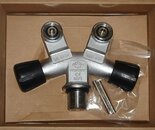
This makes a lil' more sense to me now. There are a bunch of o-rings on the H-valve. I had never seen a Y-valve like the ones in post #8. The Ones I had seen had knobs that were definatley not DIR, but I like those valves. I wish I would have seen em' before I bought the H-valve. Oh well.
I've seen that Y valve on a tank, but never without, so that is pretty interesting that it has two dip tubes. Does it really have independent air paths?