


You are using an out of date browser. It may not display this or other websites correctly.
You should upgrade or use an alternative browser.
You should upgrade or use an alternative browser.
nitrox stick plans
- Thread starter mbsdiver
- Start date
Please register or login

Welcome to ScubaBoard, the world's largest scuba diving community. Registration is not required to read the forums, but we encourage you to join. Joining has its benefits and enables you to participate in the discussions.
Benefits of registering include
- Ability to post and comment on topics and discussions.
- A Free photo gallery to share your dive photos with the world.
- You can make this box go away


Wookie
Proud to be a Chaos Muppet
Staff member
ScubaBoard Business Sponsor
ScubaBoard Supporter
Scuba Instructor
I built a trimix stick. It works great. Don't need a nitrox stick because I have a membrane. It looks exactly like a piece of 3" PVC pipe. All if the interesting bits are inside. I didn't find the plans, I used both of my engineering degrees to design it.
As you've been told in other threads, Vince Harlow's book, the Oxyhackers Handbook available here is an invaluable resource for you. You'll find out about compressor oils, where to put the O2 analyzer, and many other things you might be interested in.
As you've been told in other threads, Vince Harlow's book, the Oxyhackers Handbook available here is an invaluable resource for you. You'll find out about compressor oils, where to put the O2 analyzer, and many other things you might be interested in.

A "nitrox stick" is nothing more than a pipe that thoroughly mixes air and oxygen before the mixture is fed into the intake manifold of a compressor. There's nothing special or magical about it.
The baffles inside of the nitrox stick that mix the air should be made of a material that is easily cleaned to oxygen standards and does not feed particulate matter into the compressor. For example, foam or fiber would be very poor choices for baffle material.
Usually there is an oxygen analyzer between the nitrox stick and the compressor, so that you can measure in real time the Nitrox mix that you are creating as you feed in oxygen.
Too many baffles, and the compressor has to pull too hard to suck air through the nitrox stick. Too few baffles and the air and oxygen is not mixed adequately, resulting in spikes of oxygen going into the compressor (explosion hazard).
Ideally, a homemade stick would contain a repeating number of baffles like Wiffle balls that can be added to increase mixing or substracted to reduce resistance.
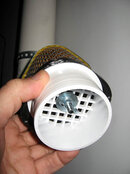
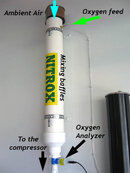
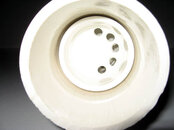
Here is my Nitrox stick. I have a lawn-mower air filter sitting on top to keep gross material out of the stick. I used PVC end caps with drilled holes as my baffles. Initially I had 4 baffles but there was too much resistance, so I removed one. I can set the oxygen valve and get a steady blend within 0.1% of my target.
The baffles inside of the nitrox stick that mix the air should be made of a material that is easily cleaned to oxygen standards and does not feed particulate matter into the compressor. For example, foam or fiber would be very poor choices for baffle material.
Usually there is an oxygen analyzer between the nitrox stick and the compressor, so that you can measure in real time the Nitrox mix that you are creating as you feed in oxygen.
Too many baffles, and the compressor has to pull too hard to suck air through the nitrox stick. Too few baffles and the air and oxygen is not mixed adequately, resulting in spikes of oxygen going into the compressor (explosion hazard).
Ideally, a homemade stick would contain a repeating number of baffles like Wiffle balls that can be added to increase mixing or substracted to reduce resistance.
Here is my Nitrox stick. I have a lawn-mower air filter sitting on top to keep gross material out of the stick. I used PVC end caps with drilled holes as my baffles. Initially I had 4 baffles but there was too much resistance, so I removed one. I can set the oxygen valve and get a steady blend within 0.1% of my target.
Attachments

This is the manufacturer of the mixing chamber purchased by EnviroDive to incorporate in their Nitrox Stick. I would give them a call to see if a DIY version is worth it to you.
Static Tube Mixer | Koflo Corporation
Here are some plans for a roll-your-own, similar to the design in Vance Harlow's Oxygen Hacker's Companion:
Mixing Stick
Static Tube Mixer | Koflo Corporation
Here are some plans for a roll-your-own, similar to the design in Vance Harlow's Oxygen Hacker's Companion:
Mixing Stick
...was just interested in what people did to put their own twist on it.
Resistence is proportional to diameter, so I went with a shorter/wider stick than a narrower/longer stick.
Do what ever is easiest for you to accomplish the goal. I doesn't take a lot to get good mixing.

Peter_C
Contributor
We use a home built stick based on Oxyhacker's guide. When I got the air filter it was something they had on the shelf for a long time and made me an awesome deal...free! Couldn't tell you what it is for and nor did they know. There is also a foam wrap over the top of the paper element.
I would highly recommend a O2 shut off valve and relay. Thread below has more info.
http://www.scubaboard.com/forums/co...-blending-systems/403418-nitrox-blending.html
CO meters are also something to investigate too.
I would highly recommend a O2 shut off valve and relay. Thread below has more info.
http://www.scubaboard.com/forums/co...-blending-systems/403418-nitrox-blending.html
CO meters are also something to investigate too.

Scuba Duck
Contributor
The Koflo mixers on this website is not what is inside the Envirodive Nitrox Stik. The Nitrox Stik uses a more expensive helical element that doesn't reduce the cross sectional area or cause as much pressure drop. The elements in the Nitrox Stik cause the flow to rotate in one direction, then turn and rotate in the opposite direction, then change direction and rotate in the initial direction. Think fixed counter rotational propellor blades that cause the air to spin. Its not a simple turbulent path. This is a much more efficient design as it mixes better and causes less restriction (no decrease in cross sectional area). Its also beyond the capabilites of most individuals to manufacture.
I have used the above static mixers in other applications, they cause a noticable drop in pressure in the piping.
I have used the above static mixers in other applications, they cause a noticable drop in pressure in the piping.
The Koflo mixers on this website is not what is inside the Envirodive Nitrox Stik. The Nitrox Stik uses a more expensive helical element that doesn't reduce the cross sectional area or cause as much pressure drop. ….
Like this one? PVC Static Mixers, Clear Static Mixers | Koflo Corporation
Scuba Duck
Contributor
Nope. That is made from flat stock PVC, shoved into a pice of clear tube. Works, but causes relatively high differential pressure. Nitrox Stik elements are helical. Stacked to cause rotation in opposite directions.
More like this: Helicoid - Wikipedia, the free encyclopedia.
Similar threads
- Replies
- 20
- Views
- 2,329


- Replies
- 14
- Views
- 1,196
- Replies
- 8
- Views
- 457


- Replies
- 20
- Views
- 2,314