


Welcome to ScubaBoard, an online scuba diving forum community where you can join over 205,000 divers from around the world discussing all things related to Scuba Diving. To gain full access to ScubaBoard (and make this large box go away) you must register for a free account. As a registered member you will be able to:
Participate in over 500 dive topic forums and browse from over 5,500,000 posts.
Communicate privately with other divers from around the world.
Post your own photos or view from well over 100,000 user submitted images.
Gain access to our free classifieds marketplace to buy, sell and trade gear, travel and services.
Use the calendar to organize your events and enroll in other members' events.
All this and much more is available to you absolutely free when you register for an account, so sign up today!
If you have any problems with the registration process or your account login, please contact the ScubaBoard Support Team.
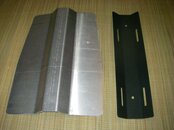
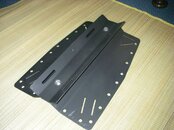
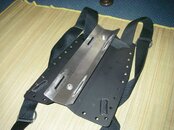
I just finished making my own aluminum backplate and STA. I also made an STA from stainless steel. My first attempt at making my own dive stuff. I had access to a shear and brake to cut and shape the plate and STA. I drilled all of the holes with a cordless drill in my kitchen. The slots were all chain drilled and finished with a sanding disk, similar to a dremel tool.
Now I just need to get an Oxychec single tank wing, a buckle and 2 tank straps and I'm ready to dive.
I thought about making my BP, but I wanted it in SS and it wasn´t gonna be that cheap. Plus I got a pretty good deal on my Halcyon BP+wing+STA so I gave it up.
I probably wouldn't bother to make one out of stainless. 1/8" stainless takes more work to drill and cut the slots, not to mention bending.
When the time comes I'll buy one made of stainless. Aluminum was pretty easy to do though.
First I sanded the surface with 320 grit sand paper, then wiped clean with alcohol. Acetone would be better but alcohol works well also.
Next I used a chemical called alodine to etch the aluminum. You just brush the alodine onto the surface, it'll make it look sort of a gold color.
This helps the primer to adhere. Just sanding and cleaning with acetone or alcohol will do fine as an etcher if you don't have alodine.
I primed with one coat of epoxy primer (spray can). Let dry.
Then two coats of flat black epoxy paint (also spray can).
It'll all eventually get scratched up which I don't mind. I just wanted to give it an initial coating to prevent any widespread oxidation (the powdery surface look that aluminum eventually gets.)
It'll get rinsed after a dive, so I could've probably done no painting at all. But I figured black is always a good choice.
If you got a gold color it sounds like you used Alodine 1200 or 1200S. Any paint will chip at the corners over time and you will most likely end up with corrosion running under the paint. It is just the way it is. After rinsing, make sure the plate and all of the webbing is dry before storing and make sure that you never have any stainless steel or other metal in contact with it over time.
On aircraft we use Alodine (which is chromated) with a Mil-Spec chromated epoxy primer (Mil-PRF-23377 or Mil-PRF-85582) with a Poly topcoat (Mil-PRF-85285 for Navy aircraft) on internal structure only. For external we use an anodize meeting MIL-A-8625 Type I, Type II, and Type III (Type III for no fatigue loaded parts only).
For this application I would recommend a Type III anodize which can be dyed to a number of colors.
Many anodize houses may say they use Type I but are really using Type IB which is run at 20 volts vs. Type I which is run at 40 volts. Both Type I and Type IB should be anodize for 45 to 55 minutes. The difference is that Type I has almost 3 times the oxide thickness as Type IB. Type II results in just about the same oxide coating as Type I but uses a different chemistry in the bath.
A legitimate adventure has no predetermined outcome. - Chatterton
A flawlessly working rebreather is almost as dangerous as a completely unreliable unit since reliability encourages complacency. - Howard Hall stating the Richard Pyle Paradox
Decompression algorithms are akin to measuring with a micrometer, marking with chalk and cutting with an ax. - Rick Murchison
<form action="https://www.paypal.com/cgi-bin/webscr" method="post"> <input name="cmd" value="_s-xclick" type="hidden"> <input name="hosted_button_id" value="GYWR5TJFW8A5G" type="hidden"> Read this and protect our right to post on ScubaBoard!
<input src="https://www.paypal.com/en_US/i/btn/btn_donateCC_LG.gif" name="submit" alt="PayPal - The safer, easier way to pay online!" type="image" border="0"> https://www.paypal.com/en_US/i/scr/pixel.gif
</form>to ScubaBoard's Legal Defense Fund