Welcome to ScubaBoard, an online scuba diving forum community where you can join over 205,000 divers diving from around the world. If the topic is related to scuba diving, this is the place to find divers talking about it. To gain full access to ScubaBoard (and make this large box go away) you must register for a free account. As a registered member you will be able to:
Participate in over 500 dive topic forums and browse from over 5,500,000 posts.
Communicate privately with other divers from around the world.
Post your own photos or view from well over 100,000 user submitted images.
Gain access to our free classifieds marketplace to buy, sell and trade gear, travel and services.
Use the calendar to organize your events and enroll in other members' events.
Find a dive buddy or communicate directly with scuba equipment manufacturers.
All this and much more is available to you absolutely free when you register for an account, so sign up today!
If you have any problems with the registration process or your account login, please contact the ScubaBoard Support Team.
My wonderful wife (scubasweety) gave me a great new digital camera (a570is) to replace my old film camera for our trip down south this year. The only problem is my strobe will only work with the new camera in full manual mode so…What f/stop & shutter speed should I use and what film speed. I would love to just buy a new strobe but cash is tight. Any help would be great. We leave for Cozumel Jan 6th so my clock is ticking. Merry Christmas!
Here you go, ............I shoot my A570 on Av & leave the ISO on 80 all the time(the lowest it has)......so basically all I'm changing is the F-stop, start @ about 5 & go down to about 2.8? when & if I get a chance to bracket......Try to use macro all the time & flash unless I'm shooting toward the surface or near the surface where I take advantage of ambient lite and use no flash at all.....The only time I'll change from this is when shooting silhouettes(directly into the sun) & I'll put my F-stop as high as the camera goes, I think around 8 something(don't have the camera in front of me)----in the old days, used F-22 on my 35 mm S&S MM II.....
btw, I use no strobe(in the below pictures), only the camera's internal flash........good luck......also, alcina gave me most of this info....try to find one of her posts here on SB, she's got alot more info in her sig & remember---she's the Canon guru here, if she speaks, you listen.........GEAUX TIGERS.....
I would suggest starting with an F-stop in the 5 to 6 range and a shutter speed of 80. The real key is to understand what each setting does for you. For the most part, the F-shop and strobe level control the near ground exposure, if your close in subjects are over exposed, lower the strobe level or go to a larger number F-stop, the reverse if they are underexposed. The background, areas past where the strobe will effectively light, is controlled by shutter speed. The slower the speed the lighter blue the background will be. Depending on your subject and your skill, speeds lower than 1/60th are hard to keep still enough to prevent blurring the subject.
A good way to learn how to use the controls is to shoot outside in the evening, a little before sunset. Set up some object...I like a flower arrangement.. a few feet from your camera. Fill the frame with mostly the subject but have at least 25% of the photo as blue sky. Start with you camera set to F-5.6, speed at 100 and strobe at full power. Adjust the F-stop and strobe power to get a good exposure. This is a really good time to learn how to use a histogram if you camera has one, the cameras LCD will often not show an accurate depiction of the actual exposure of the shot....it will lie to you...the histogram will not, it’s your friend, learn to use it.. Note that the sky will remain pretty much the same color and lightness no matter what you set the F-stop or strobe to. Once you get the near field exposure set, play with the shutter speed. You will find that as you increase the speed, the sky gets darker and darker until it's black but the exposure of the near field items only change slightly. (This does need to be done in late afternoon to simulate the lower light conditions that are normal in diving). I have a series of photos that I took to demonstrate the effects of shutter speed, Fstop and strobe power. I will try to add them this evening.

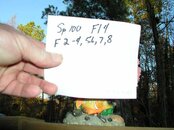
Here are some examples. In the first set, the strobe and Fstop (F8) remain the same, the time is varied from 40,60,80,100,200,500 and 1000th of a second. The photos were all taken within a couple of minutes. The blue background gets darker and darker as the shutter speed is increased but the "reef" changes very little, not enough I would bother to correct for.
Last edited by herman; December 27th, 2007 at 01:24 PM.
In this set, the flash and shutter speed remain the same, only the Fstop is changed. The F-stop is varied from F2, 4, 5.6,7 and 8. The exposure of the forground changes a lot at first but once the F-stop gets into a range the camera can handle, around F4, the backrground does change but only slightly. A decreas in shutter speed would bring it back up. I might add that changing the strobe power will have the same effect except there will be no changes in the backgound exposure. For that reason I prefer to use strobe power if the strobe is capable of it (and it's a lot easier to change the strobe level than the F-stop ). This series of photos were taken within a couple of minutes (and within several minutes of the other set). All were taken with the camera on a tripod and using the cameras internal flash, adjusted to the proper level.
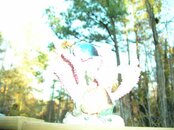
I find it really helpful to take start and stop photos between the series of shots.....darn site easier than trying to remember what I was shooting at the time, the last photos is the start photo I made for this series.
I would like to add that the f/stop chosen will influence depth of field.
The larger the diameter of the aperture measures (f/stop such as f/2.8), the less depth of field captured in the image. The smaller the diameter of the aperture (f/stop such as f/8), the greater the depth of field.
As a side bar, in case anyone is wondering why an aperture larger in diameter (more glass allowing more light to pass through) is designated with a smaller "number" ..........the term "f/stop" actually refers to a fractional number (and therefore the reason for the "/" sign).
The f/stop describes relationship between the diameter of the aperture (lens) and the focal length (distance between lens and capture media.....in this case most likely a sensor.......a "long time ago" most likely film). The f/number is the focal length divided by the aperture.
For instance, an aperture measuring 25mm wide when combined with a 50 mm focal length would be denoted as f/2. An aperture that measures only 10 mm across combined with the same focal length of 50mm would then be described as f/5.
"We will not be driven by fear into an age of unreason, if we dig deep into our own history and our doctrine and remember that we are not descended from fearful men, not men who feared to write, to speak, to associate, and to defend causes which were for the moment unpopular." E.R. Murrow, 1951